Human Use
The Great Barrier Reef has long been known to and used by the Aboriginal Australian and Torres Strait Islander peoples. Aboriginal Australians have been living in the area for at least 40,000 years,[108] and Torres Strait Islanders since about 10,000 years ago.[109] For these 70 or so clan groups, the reef is also an important cultural feature.[110
In 1768 Louis de Bougainville found the reef during an exploratory mission, but did not claim the area for the French.[111] On 11 June 1770, HM Bark Endeavour, captained by explorer James Cook, ran aground on the Great Barrier Reef, sustaining considerable damage. Lightening the ship and re-floating it during an incoming tide eventually saved it.[112] One of the most famous wrecks was HMS Pandora, which sank on 29 August 1791, killing 35 men. The Queensland Museum has led archaeological digs to wreck of Pandora since 1983.[113] Because the reef had no atolls, it was largely unstudied in the 19th century.[30]: 7 During this time, some of the reef's islands were mined for deposits of guano, and lighthouses were built as beacons throughout the system.[30]: 452 as in Raine Island, the earliest example.[114] In 1922, the Great Barrier Reef Committee began carrying out much of the early research on the reef.[30]: 9
Management
Royal Commissions disallowed oil drilling in the Great Barrier Reef, in 1975 the Government of Australia created the Great Barrier Reef Marine Park and prohibited various activities.[115] The Great Barrier Reef Marine Park does not include the entire Great Barrier Reef Province.[27] The park is managed, in partnership with the Government of Queensland, through the Great Barrier Reef Marine Park Authority to ensure that it is used in a sustainable manner. A combination of zoning, management plans, permits, education and incentives (such as eco-tourism certification) are employed in the effort to conserve the reef.[59][116]
In 1999, the Australian Parliament passed the Environment Protection and Biodiversity Conservation Act, which improved the operation of national environmental law by providing guidance about regional biodiversity conservation priorities. The marine bioregional planning process came from the implementation of this law. This process conserves marine biodiversity by considering the whole ecosystem a species is in and how different species interact in the marine environment.
Tourism
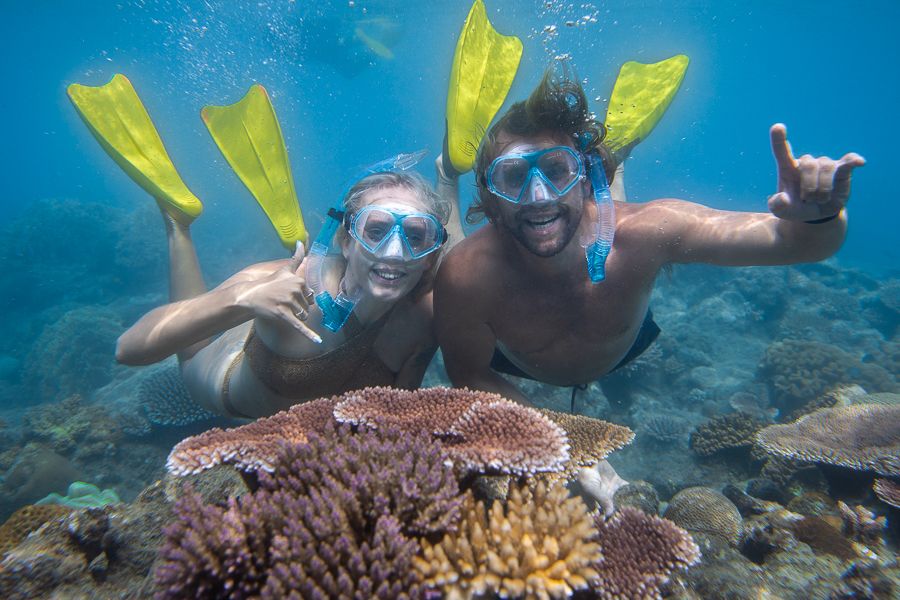
Due to its vast biodiversity, warm clear waters and accessibility from the tourist boats called "live aboards", the reef is a very popular destination, especially for scuba divers. Tourism on the Great Barrier Reef is concentrated in Cairns and also The Whitsundays due to their accessibility. These areas make up 7–8% of the park's area.[59] The Whitsundays and Cairns have their own Plans of Management.[130] Many cities along the Queensland coast offer daily boat trips. Several continental and coral cay islands are now resorts, including Green Island and Lady Elliot Island. As of 1996, 27 islands on the Great Barrier Reef supported resorts.[59]
In 1996, most of the tourism in the region was domestically generated and the most popular visiting times were during the Australian winter. At this time, it was estimated that tourists to the Great Barrier Reef contributed A$776 million per annum.[131] As the largest commercial activity in the region, it was estimated in 2003 that tourism generated over A$4 billion annually,[132] and the 2005 estimate increased to A$5.1 billion.[130] A Deloitte report published by the Great Barrier Reef Marine Park Authority in March 2013 states that the Reef's 2,000 kilometres of coastline attracts tourism worth A$6.4 billion annually and employs more than 64,000 people.[133]
Approximately two million people visit the Great Barrier Reef each year.[134] Although most of these visits are managed in partnership with the marine Tourism industry, there is a concern among the general public that tourism is harmful to the Great Barrier Reef.[59]
A variety of boat tours and cruises are offered, from single day trips, to longer voyages. Boat sizes range from dinghies to superyachts.[135] Glass-bottomed boats and underwater observatories are also popular, as are helicopter flights.[136][137] By far, the most popular tourist activities on the Great Barrier Reef are snorkelling and diving, for which pontoons are often used, and the area is often enclosed by nets. The outer part of the Great Barrier Reef is favoured for such activities, due to water quality.[citation needed]
Management of tourism in the Great Barrier Reef is geared towards making tourism ecologically sustainable. A daily fee is levied that goes towards research of the Great Barrier Reef.[130] This fee ends up being 20% of the GBRMPA's income.[138] Policies on cruise ships, bareboat charters, and anchorages limit the traffic on the Great Barrier Reef.[130]
The problems that surround ecotourism in the Great Barrier Reef revolve around permanent tourism platforms. Platforms are large, ship-like vessels that act as a base for tourists while scuba diving and snorkelling in the Great Barrier Reef. Seabirds will land on the platforms and defecate which will eventually be washed into the sea. The feces carry nitrogen, phosphorus and often DDT and mercury, which cause aspergillosis, yellow-band disease, and black band disease. Areas without tourism platforms have 14 out of 9,468 (1.1%) diseased corals versus areas with tourism platforms that have 172 out of 7,043 (12%) diseased corals.[139] Tourism is a major economic activity for the region. Thus, while non-permanent platforms could be possible in some areas, overall, permanent platforms are likely a necessity. Solutions have been suggested to siphon bird waste into gutters connecting to tanks helping lower runoff that causes coral disease.[140]
Fishing
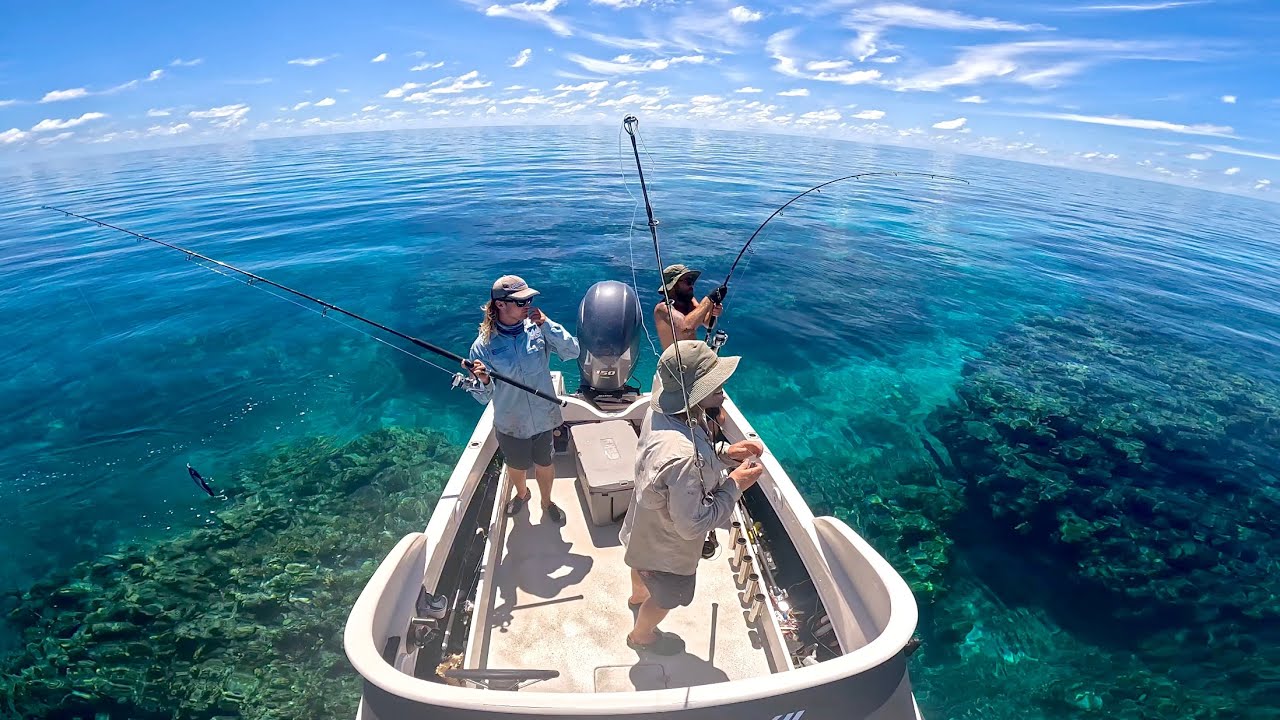
The fishing industry in the Great Barrier Reef, controlled by the Queensland Government, is worth A$1 billion annually.[15] It employs approximately 2000 people, and fishing in the Great Barrier Reef is pursued commercially, for recreation, and as a traditional means for feeding one's family.
Dugong Hunting
Under the Native Title Act 1993, native title holders retain the right to legally hunt dugongs and green turtles for "personal, domestic or non-commercial communal needs".[141][unreliable source?] Four traditional owners groups agreed to cease the hunting of dugongs in the area in 2011 due to their declining numbers, partially accelerated by seagrass damage from Cyclone Yasi.[142]